

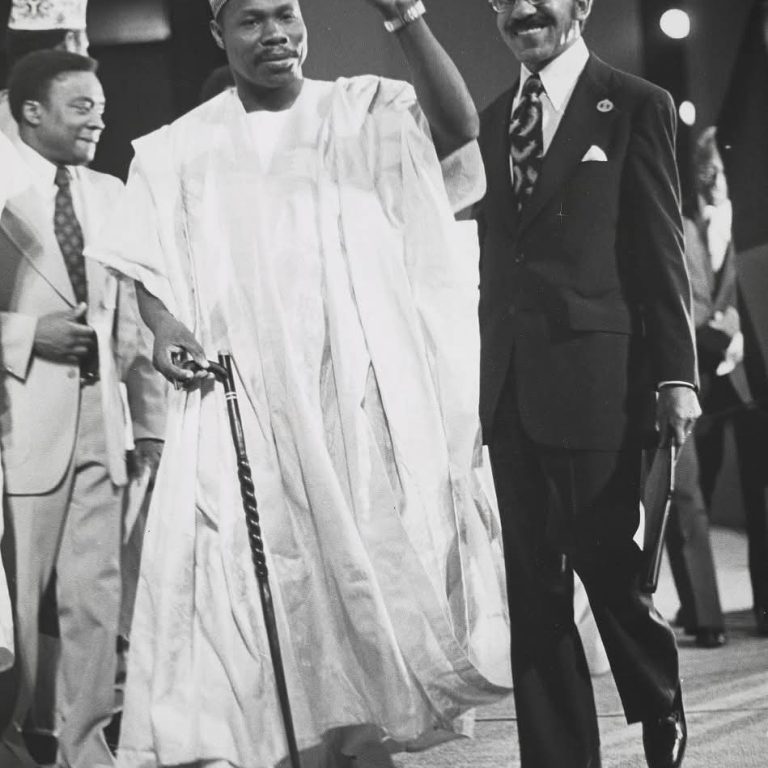
This photograph, taken at Howard University, Washington, D.C., in September 1977, captures a significant moment featuring Nigerian Head of State General Olusegun Matthew Okikiola Aremu Obasanjo alongside Howard University President James E. Cheek. More than a routine meeting, the image reflects the growing connections between postcolonial African leadership and major African American institutions during the 1970s, a period when questions of Black identity, global solidarity, education, and diplomacy were deeply intertwined.
At the time the photograph was taken, Olusegun Obasanjo was serving as Nigeria’s military Head of State, a position he held from 13 February 1976 to 1 October 1979 following the assassination of General Murtala Muhammed. Obasanjo’s administration is widely remembered as a transitional one. Although he was a military ruler, he distinguished himself by supervising a return to civilian government and, in 1979, handing over power to an elected president, Alhaji Shehu Shagari. This made him one of the few African military leaders of his era to voluntarily transfer power to a civilian administration, a fact that gave him considerable international attention and respect.
His presence at Howard University in 1977, therefore, carried both political and symbolic weight. Howard, one of the most prestigious historically Black universities in the United States, has long served as a centre of Black intellectual life, leadership, and international exchange. For an African head of state to be received there was not simply ceremonial. It represented the importance of dialogue between Africa and the African diaspora at a time when many African nations were still defining their post-independence identities and African American institutions were increasingly engaging with global Black struggles and aspirations.
Standing beside Obasanjo in the image is Dr James Edward Cheek, who served as president of Howard University from 1969 to 1989. Cheek was an influential educator and administrator whose presidency spanned a crucial period in the university’s history. Under his leadership, Howard strengthened its academic profile, expanded its global outlook, and became an even more visible platform for conversations about Black empowerment, higher education, and international affairs. His meeting with Obasanjo reflected Howard’s role not only as an American university, but as an intellectual crossroads for leaders across Africa and the diaspora.
The timing of the image is also important. The late 1970s were a period in which Nigeria was becoming increasingly prominent on the African continent and internationally. Flush with oil wealth and newly assertive in foreign affairs, Nigeria presented itself as a major African power.
The country was active in anti-colonial and anti-apartheid causes and sought to strengthen its voice within Africa and the wider Black world.
Obasanjo’s visit to an institution like Howard thus aligned with Nigeria’s broader diplomatic posture of leadership, influence, and Pan-African engagement.
Seen in this context, the photograph represents more than an official courtesy call. It is a visual record of a moment when African state power and African American institutional prestige met on shared symbolic ground.
Howard University represented scholarship, Black advancement, and diasporic leadership. Obasanjo, as Nigeria’s ruler, represented the authority and ambitions of one of Africa’s largest and most influential nations. Their meeting suggested mutual recognition: the recognition by African leaders of the importance of Black institutions in the United States, and the recognition by those institutions of Africa’s central place in global Black history and politics.
Photographs such as this one are valuable because they preserve the quiet but meaningful encounters that formal histories sometimes overlook. They remind us that diplomacy is not shaped only in presidential palaces, foreign ministries, or summit halls, but also in universities, lecture spaces, and cultural institutions. Howard University, in particular, has often been a site where politics, scholarship, and symbolic representation meet. Obasanjo’s appearance there in 1977 fits into that longer tradition.
Today, the image stands as an important historical artifact of Nigeria–diaspora relations, Black internationalism, and the political culture of the 1970s. It captures two prominent figures from different but connected worlds: one, a Nigerian military ruler overseeing a national transition; the other, a leading African American university president guiding one of the world’s most important Black educational institutions. Together, they represent a moment of contact between Africa and the diaspora that was both diplomatic and deeply historical.
Source: Smithsonian National Museum of African American History and Culture, Gift of Milton Williams Archives, 2011.15.38.